Purpose of this session is to share importance of Inheritance. We will discuss about C++ inheritance in short. Also we will discuss the importance different types of inheritance with Example.
What is Inheritance?
Process of inheritance is, “Object of one class can acquire the properties of another class.”. Lets take an example I have a base class “birds”. It has some properties & methods. If I want to distinguish between flying & non-flying birds then these classes can be derived from birds class (As the base class). Because common methods & properties for flying birds & non-flying birds must be there is birds class.
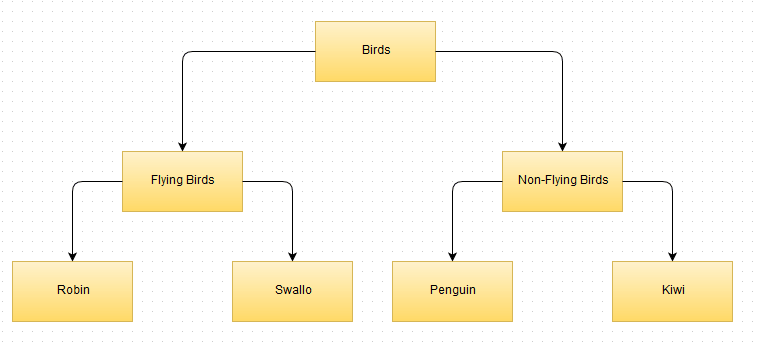
Fig: Example of Inheritance
Example of Inheritance
Inheritance supported by high level languages like c++, java, c sharp, javascript or python. Here to present you a real-time example I am sharing inheritance in js. In the below Codes I have a person class with 4 properties. I am inheriting Teacher class from the base class person. Teacher class has 5 properties. 4 properties from person class and 1 additional property salary.
// Constructor Class
function person(firstname, lastname, age, gender) {
this.name = { firstname, lastname };
this.age = age;
this.gender = gender;
};
// Prototyping Person Class
person.prototype.greeting = function() {
alert('Hi! I\'m ' + this.name.firstname + '.');
};
var personInstance = new person("Bikash", "Dash", 27, "M", 20000);
personInstance.greeting();
// Teacher Class inherits from Person Class
function Teacher(firstname, lastname, age, gender, salary) {
person.call(this, firstname, lastname, age, gender);
this.salary = salary;
}
// To assign Person prototype we have to Create Prototype for Teacher
Teacher.prototype = Object.create(person.prototype);
var newTeacher = new Teacher("Baby", "Roy", 26, "F", 30000);
alert(newTeacher.name["firstname"]);
alert(newTeacher.gender);
// After Teacher.Prototype only this will work
newTeacher.greeting();
Here if we alert(Teacher.prototype.constructor); it will show Person Class Constructor. To display Teacher Class Constructor we have to execute the following line of Code.
Teacher.prototype.constructor = Teacher;
Types of Inheritance
There are 5 types of Inheritance available in Object Oriented Programming (OPPs), Those are as below:
- Single Inheritance
- Multilevel Inheritance
- Multiple Inheritance
- Hierarchical Inheritance
- Hybrid Inheritance
1. Single Inheritance
Single inheritance is very much easy to understand. One class that is derived class extends another class or base class this mechanism is Single inheritance.

Fig: Single Inheritance
Refer to the above example think you have a base class Office. While Creating an Employee Class for Office related properties you can get in Office class. Here two things comes into picture base class & derived class. This scenario is called Single Inheritance.
2. Multilevel Inheritance
One derived class extends from another derived class this mechanism is known as Multilevel Inheritance.
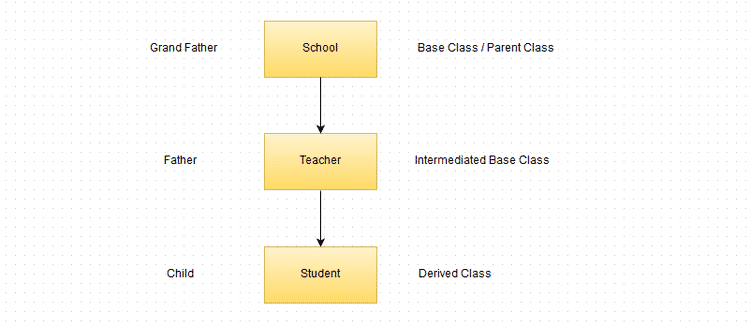
Fig: Multilevel Inheritance
Sometime it happens a derived class brings property from parent of parent class. Lets talk about your Grand Father here your parents are the derived class for your grand father & you are the derived class for your parents. But you have some properties of your Grand Father.
3. Multiple Inheritance
In Multiple Inheritance, there are several base classes with single derived class. The issue with this inheritance is that more than one base class will have to manage by single derived class.
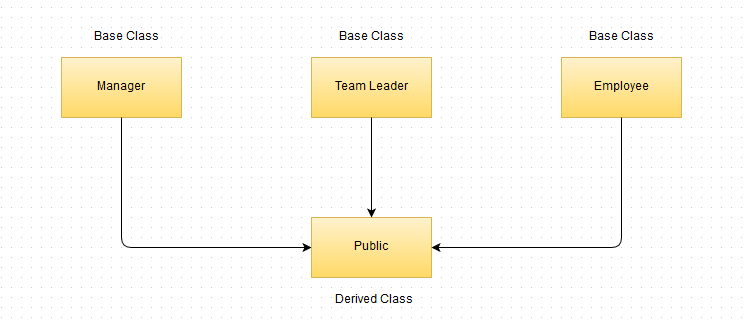
Fig: Multiple Inheritance
In the software projects, Multiple Inheritance is very rarely used. C++ supported the Multiple Inheritance.
4. Hierarchical Inheritance
In Hierarchical Inheritance, one class is inherited by more than one class.
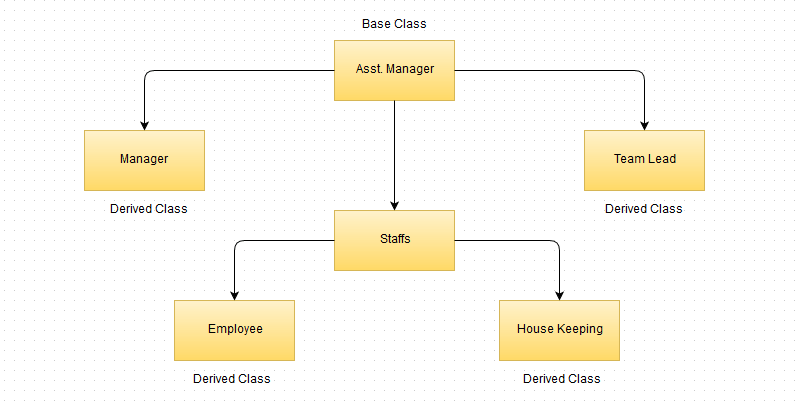
Fig: Hierarchical Inheritance
5. Hybrid Inheritance
Combination of Single Inheritance and Multiple Inheritance are called as Hybrid Inheritance. More than one type of inheritance is used in the different design.
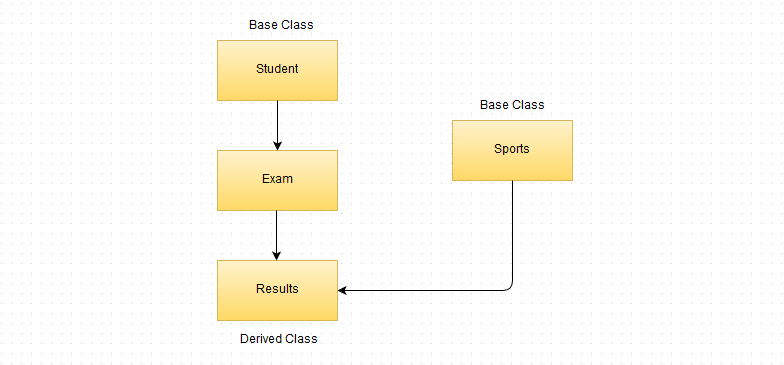
Fig: Hybrid Inheritance
Advantages of Inheritance in OOP
Inheritance is a fundamental concept in Object-Oriented Programming (OOP) that facilitates code reusability, improves organization, and enhances maintainability of software applications. By allowing a new class to inherit properties and behaviors from an existing class, inheritance streamlines the development process and promotes a clear structure within the codebase. This article explores the various advantages of inheritance in OOP, demonstrating its significance in modern software development.
## Code Reusability
One of the primary benefits of inheritance is code reusability. Developers can create a base class that encapsulates common functionality, which can then be inherited by multiple derived classes. This reduces redundancy, as shared code does not need to be rewritten in each subclass. For example, if a base class defines a method for calculating the area, multiple shapes derived from this class can inherit the method, ensuring consistency and diminishing the likelihood of errors.
## Simplified Maintenance
Inheritance simplifies maintenance by centralizing common behaviors in a single location. If a change is required in the base class, such as a modification of a method, all derived classes automatically inherit this update. This minimizes the risk of bugs that can arise from inconsistent implementations across multiple classes. Consequently, developers can focus on enhancing the base class without needing to make repetitive changes throughout the codebase.
## Enhanced Organization
Inheritance fosters better organization of code through a hierarchical structure. This structure reflects real-world relationships, making it easier for developers to understand and navigate the code. By categorizing related classes under a common parent, the codebase becomes more intuitive, enabling developers to locate and modify classes more efficiently. This organization also aids in collaborative efforts, as team members can quickly comprehend the relationships between different components of the application.
## Polymorphism
Inheritance supports polymorphism, a key principle of OOP that allows objects of different classes to be treated as objects of a common superclass. This capability is particularly advantageous in scenarios where a function needs to process a variety of objects. For instance, a method designed to handle a base class can seamlessly manage any derived class object. This flexibility enables developers to write more generalized code, which can handle a diverse range of inputs without requiring extensive modifications.
## Improved Extensibility
Inheritance promotes extensibility, allowing developers to build upon existing classes without altering their initial structure. New features can be added through derived classes, ensuring that the original functionality remains intact. This is particularly useful in evolving software projects, where requirements may change over time. By extending existing classes, developers can introduce new behaviors or properties, thus adapting the application to meet new demands.
## Logical Grouping of Related Classes
Inheritance facilitates the logical grouping of related classes, which enhances both readability and maintainability. When classes share a common base, it becomes evident that they are related, providing context for their functionality. For example, a class hierarchy representing different vehicle types (e.g., Car, Truck, Motorcycle) can be derived from a common Vehicle base class. This grouping clarifies the relationship between the classes and their shared characteristics, making it easier to understand their interactions.
## Facilitating Design Patterns
Inheritance is a cornerstone of many design patterns in software development, such as the Template Method, Strategy, and Observer patterns. These patterns leverage inheritance to promote flexible and maintainable architectures. For instance, the Template Method pattern allows subclasses to redefine certain steps of an algorithm without changing its structure, utilizing inheritance to provide a framework for behavior while allowing customization. By employing design patterns that rely on inheritance, developers can create robust and scalable applications.
## Consistency in Code
Inheritance enhances consistency across classes by ensuring that derived classes adhere to the same interface and behavior as their base class. This consistency is crucial in large applications where multiple developers may be working on different components. By establishing a common base class, developers can ensure that all derived classes implement the required methods and properties, thereby reducing the likelihood of discrepancies and improving overall application reliability.
## Encapsulation and Abstraction
Inheritance supports the principles of encapsulation and abstraction in OOP. By allowing developers to define interfaces and abstract classes, inheritance enables the creation of abstract data types that can be extended through derived classes. This abstraction hides the implementation details and exposes only the relevant functionalities, streamlining the interface for users. As a result, developers can focus on the higher-level design of the application while maintaining control over the underlying complexities.
## Facilitating Testing and Debugging
Inheritance aids in testing and debugging processes by allowing developers to isolate and verify behaviors in the base class before extending them in derived classes. This isolation ensures that foundational functionalities are working correctly before adding complexity with subclasses. Additionally, if issues arise in derived classes, developers can trace back to the base class to identify potential root causes, simplifying the debugging process. This structured approach reduces the time spent on identifying and resolving issues within the code.
## Promoting Agile Development
Incorporating inheritance into software development aligns with agile methodologies that emphasize iterative progress and adaptability. By leveraging inheritance, developers can quickly create new features and functionalities based on existing classes, allowing for rapid prototyping and testing. This agility is essential in fast-paced development environments, where requirements can shift frequently. Inheritance enables teams to remain responsive to change while maintaining a coherent code structure.
## Real-World Modeling
Inheritance allows developers to model real-world relationships more accurately within their applications. By establishing a hierarchy that reflects actual relationships (e.g., parent-child, generalization-specialization), developers can create systems that are easier to understand and interact with. This modeling capability not only enhances the user experience but also facilitates communication among stakeholders by providing a clear representation of how different components of the system relate to one another.
Conclusion
The advantages of inheritance in Object-Oriented Programming are numerous and impactful. By promoting code reusability, simplifying maintenance, enhancing organization, and facilitating polymorphism, inheritance serves as a powerful tool for developers. It improves extensibility, enables logical grouping of related classes, and supports design patterns, all while ensuring consistency in code. Furthermore, inheritance aids in encapsulation and abstraction, streamlining testing and debugging processes, and promoting agile development practices.
Ultimately, the effective use of inheritance allows for the creation of robust, maintainable, and adaptable software applications that can meet the evolving needs of users and businesses alike. By leveraging the principles of inheritance, developers can build systems that are not only efficient but also reflective of the complexities of the real world.